Planning an outdoor party sounds simple until the sun goes down. During daylight, a patio, garden, walkway, and seating area can feel naturally connected. After dark, the same space can suddenly become a collection of dark corners, awkward shadows, and poorly lit paths. That is why choosing the best landscape lighting for an outdoor party is about much more than making the backyard look attractive.
Good lighting should help guests move safely, make food and seating areas comfortable, create an inviting atmosphere, and highlight the best parts of your landscape without turning the yard into a brightly lit parking lot. A layered approach usually works better than relying on one powerful light source: pathway lights guide movement, ambient lighting creates the party mood, and accent lighting adds depth to trees, walls, plants, and architectural features.
The good news is that you do not need dozens of fixtures to achieve this effect. With thoughtful placement, warm light, suitable outdoor-rated equipment, and professional installation where electrical work is involved, an ordinary backyard can become a comfortable evening entertaining space.
What Is the Best Landscape Lighting for an Outdoor Party?
The best setup is usually a combination of three lighting layers:
- Ambient lighting for the main entertaining area
- Path and step lighting for safety and navigation
- Accent lighting for trees, walls, plants, and landscape features
This layered approach works because each light has a different job. Instead of making every part of the yard equally bright, you create brighter areas where people gather and softer illumination around the edges.
For example, imagine a backyard party with a dining table on the patio, a garden path leading to the house, and several mature trees around the lawn.
A practical arrangement could include:
- Warm string or overhead lights above the dining area
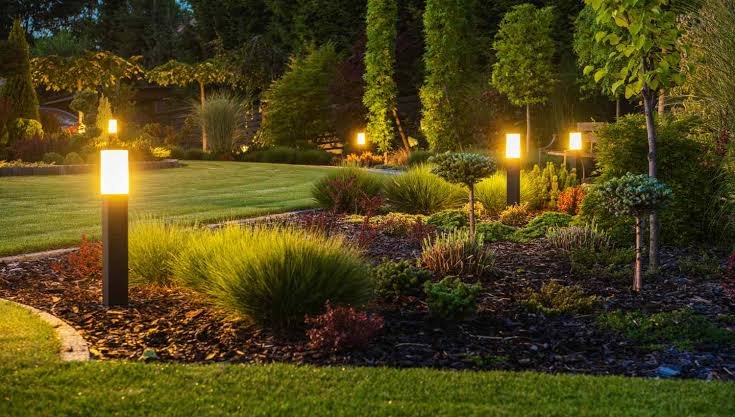
- Low path lights along the walkway
- Step lights around changes in elevation
- Uplights beneath one or two attractive trees
- Soft wall-washing lights near a textured wall
- Subtle lighting around entrances and outdoor cooking areas
This produces depth without excessive brightness.
Why Layered Lighting Works Better Than One Bright Light
A common mistake is installing one powerful floodlight and assuming it will illuminate the entire party area.
It certainly produces plenty of light, but quantity is not the same as quality.
A single bright fixture can create:
- Harsh shadows
- Glare in guests’ eyes
- Uncomfortable seating areas
- Flat-looking landscaping
- Light spilling into neighboring properties
- Poor visual contrast
Professional landscape lighting generally focuses on where the light lands rather than how much light the fixture produces. Good design highlights important features while keeping the light source itself relatively unobtrusive.
Think about a restaurant. You rarely see an enormous spotlight pointed directly at every table. Instead, different layers of lighting make the space feel comfortable and intentional.
Your backyard can work the same way.
1. Use Warm Ambient Lighting Around Seating Areas
The party’s main gathering area deserves the most attention.
If guests are eating, talking, playing games, or relaxing around a fire pit, the lighting should be bright enough for people to see comfortably without feeling like they are sitting underneath an office light.
Warm white lighting is usually a strong choice for outdoor entertaining. Residential landscape lighting commonly uses warm color temperatures around 2700K to 3000K because they create a softer, more relaxed atmosphere.
Good options include:
- String or festoon lights
- Outdoor pendants
- Covered-patio fixtures
- Wall lanterns
- Dimmable ceiling fixtures
- Soft table lanterns
A Practical Placement Tip
Do not automatically place lights directly above people’s heads.
Instead, consider where guests will actually sit and how the light will reach their faces and tables.
For a dining area, you want enough illumination to see food and conversation without producing harsh shadows across people’s faces.
If your party extends across several areas, use separate lighting zones rather than trying to illuminate everything from one location.
2. Pathway Lighting Is Essential for Guests
Path lighting is one of the most practical investments you can make before an outdoor party.
Guests may arrive after dark, walk from the driveway to the backyard, move between the patio and house, or head toward a bathroom or garden area. Even a familiar path can become difficult to navigate when furniture, decorations, and people are present.
Path lights should illuminate the walking surface rather than shine directly into people’s eyes.
A staggered arrangement on opposite sides of a walkway can create more natural coverage than placing fixtures in a rigid straight line. Several landscape lighting guides recommend spacing path fixtures at roughly 6–10 feet apart, although the correct distance depends on fixture output, pathway width, vegetation, and the amount of surrounding darkness.
Pay Special Attention to Steps
Steps deserve more attention than ordinary flat paths.
A small change in elevation can become a serious trip hazard when guests are distracted, carrying food, or talking.
Use:
- Recessed step lights
- Low wall lights
- Riser lights
- Carefully aimed path lights
The goal is to make each change in level obvious without creating glare.
3. Use Uplighting to Make Trees Look Dramatic
If your yard has a mature tree, it can become one of the most attractive features after dark.
Uplighting places a fixture near the base of a tree and aims the beam upward through the trunk and branches.
This technique works particularly well with:
- Large shade trees
- Trees with interesting bark
- Multi-trunk specimens
- Ornamental trees
- Tall palms
- Sculptural plants
However, one of the most useful lessons in landscape lighting is that you do not need to light every tree.
Choose one or two strong focal points.
Lighting every tree with the same intensity can make the yard visually flat. A darker area between illuminated features creates contrast, making the brighter features more noticeable.
There is also an environmental reason to avoid excessive garden illumination. The Royal Horticultural Society recommends keeping garden lighting focused and low where possible to reduce disruption to wildlife and avoid unnecessary light directed toward the sky.
4. Highlight Walls and Architectural Features
Walls can be surprisingly effective surfaces for outdoor lighting.
A textured stone wall, retaining wall, fence, garden boundary, or architectural feature can add depth when illuminated correctly.
Instead of pointing a bright light directly toward guests, aim light across the surface.
This technique, often called wall grazing or wall washing, can emphasize:
- Stone texture
- Brickwork
- Wood
- Decorative masonry
- Garden walls
- Columns
- Boundary features
The result is often more sophisticated than simply placing a bright fixture in front of the wall.
For larger landscape features, broader wash lights can provide even illumination, while narrower spotlights are better for individual focal points.
5. Choose the Right Lighting for Different Party Zones
One of the best ways to plan outdoor party lighting is to divide the property into zones.
Dining Zone
Use warm, comfortable ambient light.
The goal is visibility without glare.
Lounge Zone
Use softer lighting than the dining area.
String lights, subtle wall illumination, and nearby accent lighting can create a relaxed environment.
Cooking Zone
Outdoor kitchens and grills require more functional illumination.
Make sure the person preparing food can clearly see what they are doing.
Walkway Zone
Use low-level path lighting.
The fixtures should guide people without becoming visual distractions.
Feature Zone
Use accent lighting on a tree, wall, sculpture, fountain, or architectural element.
This creates visual depth.
Entrance Zone
Provide enough illumination for guests to identify the entrance, steps, door, or gate safely.
This zoning approach is more effective than simply installing identical fixtures throughout the property.
Warm vs. Cool Landscape Lighting
Color temperature can completely change the atmosphere of an outdoor party.
Warm White
Usually around 2700K–3000K.
Best suited to:
- Dining
- Lounging
- Gardens
- Trees
- Patios
- Entertaining
It tends to create a softer residential atmosphere.
Cool White
Higher color temperatures create a crisper, more neutral appearance.
They can be useful in certain modern or functional settings, but excessive cool-white lighting can make a relaxed backyard party feel more commercial or institutional.
For most residential entertaining spaces, warm lighting is the safer starting point.
Solar vs. Low-Voltage Lighting
Another common question is whether solar lighting or low-voltage landscape lighting is better.
Solar Lighting
Solar fixtures are convenient because they generally avoid the need for conventional electrical connections.
They can work well for:
- Temporary party setups
- Garden accents
- Decorative pathway lighting
- Areas where wiring is difficult
However, performance depends on sunlight, battery capacity, weather, fixture quality, and operating time.
Low-Voltage Lighting
Low-voltage LED systems are often better suited to permanent landscape lighting designs.
They provide more consistent illumination and can be integrated into a larger system with multiple fixture types.
For a permanent installation, the advantage is not simply brightness. It is the ability to design the entire property as one coordinated lighting system.
Weather Resistance Matters More Than Many Homeowners Expect
Outdoor lighting has to deal with rain, dust, humidity, temperature changes, and sometimes irrigation systems.
That means an attractive indoor fixture is not automatically suitable for outdoor use.
Pay attention to the fixture’s outdoor rating and installation location. Fixtures exposed directly to rain require appropriate weather resistance, while fittings placed in sheltered areas may have different requirements.
Before purchasing anything, ask:
- Is the fixture designed for outdoor use?
- Is it suitable for exposed weather?
- Is the electrical connection properly protected?
- Can water collect around the fixture?
- Is the cable appropriate for outdoor installation?
- Will the fixture withstand the local climate?
These questions become particularly important for permanent installations.
Why Professional Installation Can Make a Difference
Outdoor lighting may look like a simple decorative project, but permanent electrical installation involves more than positioning fixtures in the garden.
A professional can help with:
- Fixture placement
- Cable routing
- Transformer selection
- Weatherproof connections
- Load planning
- Voltage considerations
- Proper grounding and protection
- Adjusting beam angles
- Creating separate lighting zones
This is especially important where outdoor electrical systems interact with wet conditions.
If the project involves fixed electrical wiring, it is sensible to use professional installation rather than improvising electrical connections yourself. Outdoor environments introduce water and weather exposure that require appropriate equipment and installation practices.
Common Outdoor Party Lighting Mistakes
Making Everything Equally Bright
Uniform brightness removes contrast.
Some areas should remain darker so your focal points stand out.
Putting Lights Where Guests Can See the Bulb
A beautiful landscape can look surprisingly amateurish when guests are staring directly into exposed light sources.
Whenever possible, hide or shield the fixture while directing light toward the intended surface.
Ignoring Glare
A light that looks attractive from ten feet away may be uncomfortable when someone is sitting directly in its beam.
Test lighting from the positions where guests will actually sit and walk.
Overlighting the Garden
More fixtures do not necessarily create a better design.
A smaller number of carefully positioned lights can produce greater visual impact.
Forgetting the Route to the Bathroom
This is a surprisingly common party-planning oversight.
The main patio may look perfect while the route to the house or bathroom disappears into darkness.
Think about where guests will actually walk, not just where you want them to gather.
A Simple Outdoor Party Lighting Plan
If you are starting from scratch, use this order:
Step 1: Identify gathering areas.
Mark dining, lounge, cooking, and entertainment zones.
Step 2: Mark safety areas.
Identify paths, steps, gates, slopes, and changes in elevation.
Step 3: Choose focal points.
Pick one or two trees, walls, plants, or architectural features worth highlighting.
Step 4: Add ambient lighting.
Create comfortable illumination over the main seating and dining areas.
Step 5: Add path and step lighting.
Make guest movement safe and intuitive.
Step 6: Add accent lighting.
Use uplighting or wall washing to create depth.
Step 7: Test everything after sunset.
This is one of the most important steps. A fixture can look completely different once the surrounding daylight disappears.
Walk through the property from a guest’s perspective.
Sit at the dining table.
Stand in the lounge area.
Walk toward the entrance.
Then adjust brightness, angles, and fixture positions.
Three Overlooked Insights That Can Improve Your Party
1. Light the Destination, Not Just the Route
Path lighting is important, but guests also need visual cues about where they are going.
If a walkway leads to a patio, softly illuminate the patio or entrance at the end. This makes the landscape feel more intuitive because the light itself guides movement.
2. Darkness Is Part of the Design
A professional-looking outdoor space is not necessarily the brightest one.
Dark areas create contrast, mystery, and visual separation between zones.
If everything is illuminated equally, nothing feels particularly important.
3. Design for the Guest’s Eye Level
Homeowners often inspect lighting while standing up and walking around.
Guests experience the space differently.
They sit at tables, recline in chairs, look across the garden, and approach fixtures from different angles.
Before finalizing the design, evaluate the lighting from actual seating positions. This can reveal glare that is invisible during a quick walk-through.
FAQ
What is the best color temperature for outdoor party lighting?
Warm white lighting around 2700K–3000K is generally a strong choice for residential outdoor entertaining. It creates a comfortable atmosphere for dining, conversation, and relaxing. Cooler lighting can be useful for certain functional areas, but too much cool-white light can make a backyard feel harsh.
How should I light a backyard for an evening party?
Start by dividing the backyard into gathering, cooking, pathway, and feature zones. Use ambient lighting over seating areas, path and step lights for safe movement, and accent lights for trees, walls, and other landscape features. Testing the arrangement after sunset is essential because brightness and glare are difficult to judge accurately during daylight.
Are pathway lights necessary for an outdoor party?
They are highly useful when guests will be walking through the garden after dark. Pathway lighting helps people see changes in surface level and gives guests a clear route between entrances, seating areas, and other destinations. The fixtures should illuminate the ground rather than shine directly toward people’s eyes.
Is solar lighting good enough for outdoor parties?
Solar lights can work well for temporary or decorative applications, particularly where running cables is inconvenient. Their performance can vary with sunlight, battery capacity, weather, and fixture quality. For a permanent and consistently illuminated landscape, a properly designed low-voltage system may provide more predictable results.
Should landscape lighting be professionally installed?
Professional installation is particularly valuable for permanent systems involving electrical wiring, multiple fixtures, transformers, or challenging outdoor conditions. Proper installation can also improve fixture positioning, cable management, weather protection, and overall reliability. For fixed outdoor electrical work, using an appropriately qualified professional is the safer approach.
Conclusion
The best landscape lighting for an outdoor party is not necessarily the brightest or most expensive system. It is the one that makes the space feel natural, safe, comfortable, and intentionally designed after the sun goes down.
Start with the areas where people gather, then add safe illumination to paths and steps. From there, use warm accent lighting to reveal trees, walls, plants, and other features. Keep glare under control, avoid lighting every corner equally, choose fixtures designed for outdoor conditions, and test the entire layout after dark.
Most importantly, think about the experience from your guests’ perspective. They should notice the atmosphere, not the fixtures themselves. With thoughtful planning and professional installation when permanent electrical work is required, your landscape can become more than a backdrop for a party—it can become part of the experience itself.