
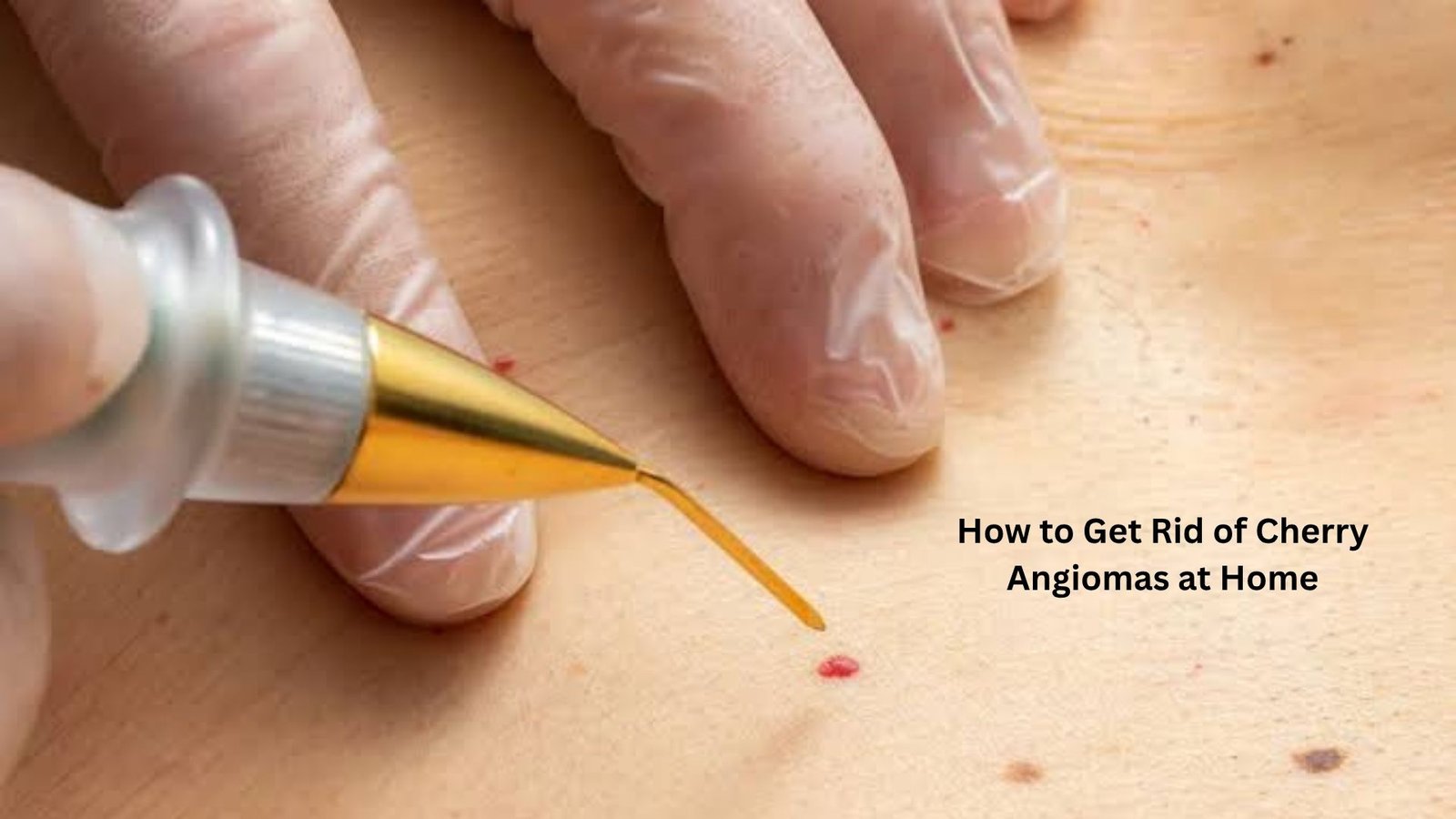
Seeing a bright-red dot suddenly appear on your skin can be unsettling—especially when several seem to show up at once. If you have been searching for how to get rid of cherry angiomas at home, you are probably hoping for a simple cream, natural remedy, or safe DIY method that will make them disappear without a dermatologist visit.
The important distinction is between making a cherry angioma less noticeable or preventing irritation and actually removing it. Cherry angiomas are small collections of blood vessels and are usually harmless. They commonly appear on the torso, arms, and legs, particularly after age 30.
Unfortunately, there is no medically established home remedy that safely removes a confirmed cherry angioma. Cutting, burning, freezing, tying it off, or applying harsh chemicals can cause bleeding, infection, burns, or permanent scarring. More importantly, not every red skin growth is a cherry angioma, so attempting DIY removal can sometimes delay the diagnosis of another condition.
The safest approach is to learn what you can realistically do at home, what you should avoid, and when professional removal makes more sense.
What Is a Cherry Angioma?
A cherry angioma is a common, benign skin growth made up of small blood vessels. It usually appears as a round red, crimson, or purple-red spot and may be completely flat or slightly raised.
Most are only a few millimeters across. They can occur individually or in groups, and they tend to become more common with age. Cleveland Clinic notes that approximately half of adults have cherry angiomas after age 30, with an even higher proportion among older adults.
Typical cherry angiomas:
- Are bright red to dark red
- Are round or oval
- May be flat or raised
- Usually do not hurt
- Can bleed if scratched, shaved, or rubbed
- Often occur on the chest, abdomen, back, arms, or legs
They generally do not require treatment unless they are frequently irritated, bleed repeatedly, or bother you cosmetically.
Why do cherry angiomas appear?
The exact cause isn’t completely understood. Aging appears to be an important factor, while hormonal changes, genetics, pregnancy, and certain chemical exposures have also been associated with their development.
One useful perspective is that getting new cherry angiomas does not necessarily mean you have done something wrong with your skincare routine.
Can You Remove a Cherry Angioma at Home?
No proven home method can safely and reliably remove a cherry angioma.
This is the most important answer for anyone searching for DIY removal.
You may find online recommendations involving:
- Apple cider vinegar
- Tea tree oil
- Garlic
- Baking soda
- Essential oils
- Dental floss or string
- Needles
- Razor blades
- At-home cautery devices
- Chemical “mole and skin tag removers”
- Home freezing products
The problem is that a cherry angioma contains blood vessels. Destroying or cutting into it can cause significant bleeding and damage the surrounding skin.
Cleveland Clinic specifically advises against attempting to remove cherry angiomas at home and recommends that trained medical professionals perform removal.
Why DIY removal can backfire
A common mistake is thinking, “It’s tiny, so removing it must be harmless.”
The size of the growth doesn’t eliminate the risks.
You could end up with:
- Bleeding — particularly if the lesion is raised and vascular.
- Infection — breaking the skin creates an entry point for bacteria.
- A permanent scar — burning or cutting can injure deeper skin.
- Pigment changes — irritation can leave darker or lighter skin.
- The wrong diagnosis — you may be treating something that isn’t a cherry angioma.
The American Academy of Dermatology also warns against using DIY products to remove skin growths because they can cause skin injuries, infection, scarring, and delayed diagnosis of skin cancer.
What Can You Safely Do at Home?
Although you cannot reliably make a cherry angioma disappear with a home remedy, you can manage it safely at home.
1. Leave it alone
This is often the best approach when the spot is small, stable, and not bothering you.
Avoid picking, scratching, squeezing, or repeatedly touching it. Irritation can make a raised angioma bleed.
If clothing or jewelry repeatedly rubs against the area, changing what touches the skin may be more useful than trying to destroy the growth.
2. Protect a bleeding angioma
If you accidentally scratch a cherry angioma and it starts bleeding, treat it like a minor skin wound.
- Apply gentle, steady pressure with clean gauze or cloth.
- Once bleeding stops, gently clean the area.
- Cover it with a clean bandage if it is likely to be rubbed.
- Keep monitoring the area while it heals.
Cleveland Clinic recommends cleaning a bleeding cherry angioma, applying antibacterial ointment, and covering it with a bandage.
If bleeding is heavy or does not stop with sustained pressure, seek medical care rather than repeatedly disturbing the lesion.
3. Reduce friction
If your angioma is on your waist, bra line, neck, or another area that frequently rubs against clothing, reducing friction can prevent repeated irritation.
This does not shrink the angioma, but it can make everyday life considerably easier.
4. Don’t try to “dry it out”
Another common misconception is that drying the angioma with an acidic or caustic substance will make it fall away.
Even if a substance damages the surface, it doesn’t mean you’ve safely removed the underlying blood vessels. You may simply create a chemical burn over the lesion.
Home Remedies for Cherry Angiomas: What About Apple Cider Vinegar?
Apple cider vinegar is frequently promoted online as a natural treatment for skin growths.
There is no established medical evidence that applying apple cider vinegar safely eliminates cherry angiomas. Because vinegar is acidic, applying concentrated products to the skin can cause irritation or chemical injury.
The same caution applies to garlic, tea tree oil, lemon juice, baking soda, and other DIY mixtures.
Natural does not automatically mean harmless.
This is particularly important on the face, neck, or areas where scarring or discoloration would be noticeable.
What About Cutting or Tying Off a Cherry Angioma?
Don’t do it.
A raised cherry angioma can look similar to a tiny skin tag, which sometimes leads people to consider tying thread or dental floss around it.
That approach is inappropriate for a vascular growth.
Cutting or strangulating a cherry angioma can cause bleeding and infection, and it may leave a scar. More importantly, you should establish what the lesion actually is before attempting to remove it.
This is one of those situations where a five-minute DIY experiment can create a skin problem that lasts for months.
How Dermatologists Actually Remove Cherry Angiomas
If you genuinely want the angioma gone, professional removal is generally the safer and more predictable route.
Common treatments include:
Electrodessication
A dermatologist uses an electrical current to destroy the blood vessels making up the angioma.
This can be particularly useful for small raised lesions.
Cryotherapy
The lesion is treated with extreme cold, usually using liquid nitrogen.
The treated area may blister, crust, or change color temporarily as it heals.
Laser treatment
A laser targets the blood vessels within the lesion.
Laser treatment can be useful when cosmetic appearance is especially important, although the best technique depends on the angioma’s size, location, and characteristics.
These are established treatment options for cherry angiomas.
Which treatment is best?
There isn’t one universally “best” procedure.
A dermatologist considers:
- Size of the angioma
- Number of lesions
- Location
- Whether it is flat or raised
- Skin type
- Likelihood of scarring or pigment changes
- Whether it has been bleeding
- Cosmetic expectations
One practical point people sometimes overlook: removing one angioma doesn’t prevent new ones from appearing elsewhere. Cherry angiomas can continue to develop with age.
When a Red Spot Shouldn’t Be Treated as a Cherry Angioma
This is perhaps the most important reason not to experiment with DIY removal.
A typical cherry angioma is usually stable and recognizable. But if a red or dark growth is changing, bleeding without obvious trauma, becoming painful, or looking unusual, it deserves professional assessment.
Consider making an appointment if you notice:
- Rapid growth
- A major change in color
- An irregular shape
- Persistent bleeding
- Repeated crusting or ulceration
- Significant pain or itching
- A lesion that looks substantially different from your other angiomas
- Uncertainty about what the growth actually is
A dermatologist can examine suspicious skin growths and determine whether further testing is necessary. The broader principle is simple: diagnose first, remove second.
Three Practical Insights People Often Miss
1. The safest “home treatment” may be prevention of irritation
If your angioma isn’t dangerous but constantly catches on clothing, your immediate problem may not be the angioma itself—it may be repeated trauma.
Changing clothing, reducing friction, and covering an irritated spot can prevent the bleeding cycle without damaging your skin.
2. A new red spot deserves observation before intervention
Instead of immediately searching for a removal product, take note of its approximate size, color, and location.
If it changes significantly, that information can be useful when you speak with a healthcare professional.
3. Cosmetic removal is still legitimate medical care
You don’t have to tolerate a benign growth simply because it isn’t medically dangerous.
If an angioma makes you uncomfortable about your appearance or repeatedly catches on clothing, professional removal is a reasonable option. The goal isn’t to treat a dangerous disease; it’s to remove an unwanted lesion safely.
Common Mistakes to Avoid
If you’re considering getting rid of a cherry angioma, avoid these mistakes:
Mistake #1: Burning it with a household object.
Heat can destroy surrounding healthy skin and create a scar.
Mistake #2: Cutting it with scissors or a razor.
Because the lesion contains blood vessels, cutting can cause bleeding and infection.
Mistake #3: Using strong acids.
Chemical burns can be much larger than the original angioma.
Mistake #4: Assuming every red bump is a cherry angioma.
Other skin conditions can look similar.
Mistake #5: Expecting skincare products to dissolve it.
Moisturizers and ordinary cosmetic products may improve surrounding skin but won’t remove the vascular growth.
Mistake #6: Repeatedly picking at it because it “almost came off.”
This can turn a harmless spot into a persistently irritated wound.
A Simple Decision Guide
If you’re unsure what to do, use this practical approach:
Small, stable, painless spot?
→ Leave it alone and monitor it.
Frequently irritated or bleeding because of clothing?
→ Protect it from friction and consider professional removal.
You dislike how it looks?
→ Ask a dermatologist about cosmetic removal.
It’s changing, unusual, painful, or you’re not sure what it is?
→ Have it examined before attempting removal.
It is actively bleeding?
→ Apply gentle pressure and care for it as a minor wound. Seek medical attention if bleeding doesn’t stop or is substantial.
Frequently Asked Questions
Can I remove a cherry angioma naturally at home?
There is no proven natural remedy that safely removes a cherry angioma. Substances such as vinegar, garlic, essential oils, or lemon juice can irritate or burn the skin without reliably eliminating the lesion. If you want it permanently removed, professional treatment is the safer option.
How can I get rid of cherry angiomas without a doctor?
You generally cannot safely remove a confirmed cherry angioma yourself. Cutting, burning, freezing, or chemically treating it can cause bleeding, infection, scarring, or skin damage. If the angioma is harmless but bothersome, a dermatologist can usually remove it using procedures such as electrodessication, cryotherapy, or laser treatment.
Does apple cider vinegar get rid of cherry angiomas?
Apple cider vinegar is commonly suggested online, but it is not an established treatment for cherry angiomas. Its acidity can irritate or damage the skin, particularly if left on for prolonged periods. It is safer not to use it as a DIY removal method.
Can I pop or cut off a cherry angioma?
No. A cherry angioma contains blood vessels, so cutting or puncturing it can cause bleeding and create an infection risk. You can also leave a scar or accidentally injure a different type of skin growth.
Do cherry angiomas go away on their own?
Usually, cherry angiomas persist rather than disappearing naturally. Some angiomas associated with hormonal changes, such as those occurring during pregnancy, may regress afterward, but typical adult cherry angiomas often remain.
What is the fastest way to permanently remove a cherry angioma?
Professional removal is generally the fastest reliable approach. Depending on the lesion, a dermatologist may use electrodessication, cryotherapy, or laser treatment. The appropriate method depends on the lesion and your skin, so an examination is preferable to choosing a DIY treatment based solely on its appearance.
Conclusion
If you’re looking for how to get rid of cherry angiomas at home, the safest answer is also the one worth remembering: there is no proven DIY method that reliably removes them without risking skin damage.
For a typical, stable cherry angioma, doing nothing is completely reasonable. Protecting it from scratching and friction can prevent unnecessary bleeding and irritation. If you want it removed for cosmetic reasons or because it repeatedly gets injured, professional options such as electrodessication, cryotherapy, and laser treatment are available.
Most importantly, don’t assume every red bump is automatically a cherry angioma. If a spot changes, behaves unusually, or you’re uncertain about its identity, getting it checked before attempting removal is the smarter step.
A harmless spot usually doesn’t need aggressive treatment—and when removal is wanted, safer professional treatment is far preferable to turning a tiny red mark into a painful scar.