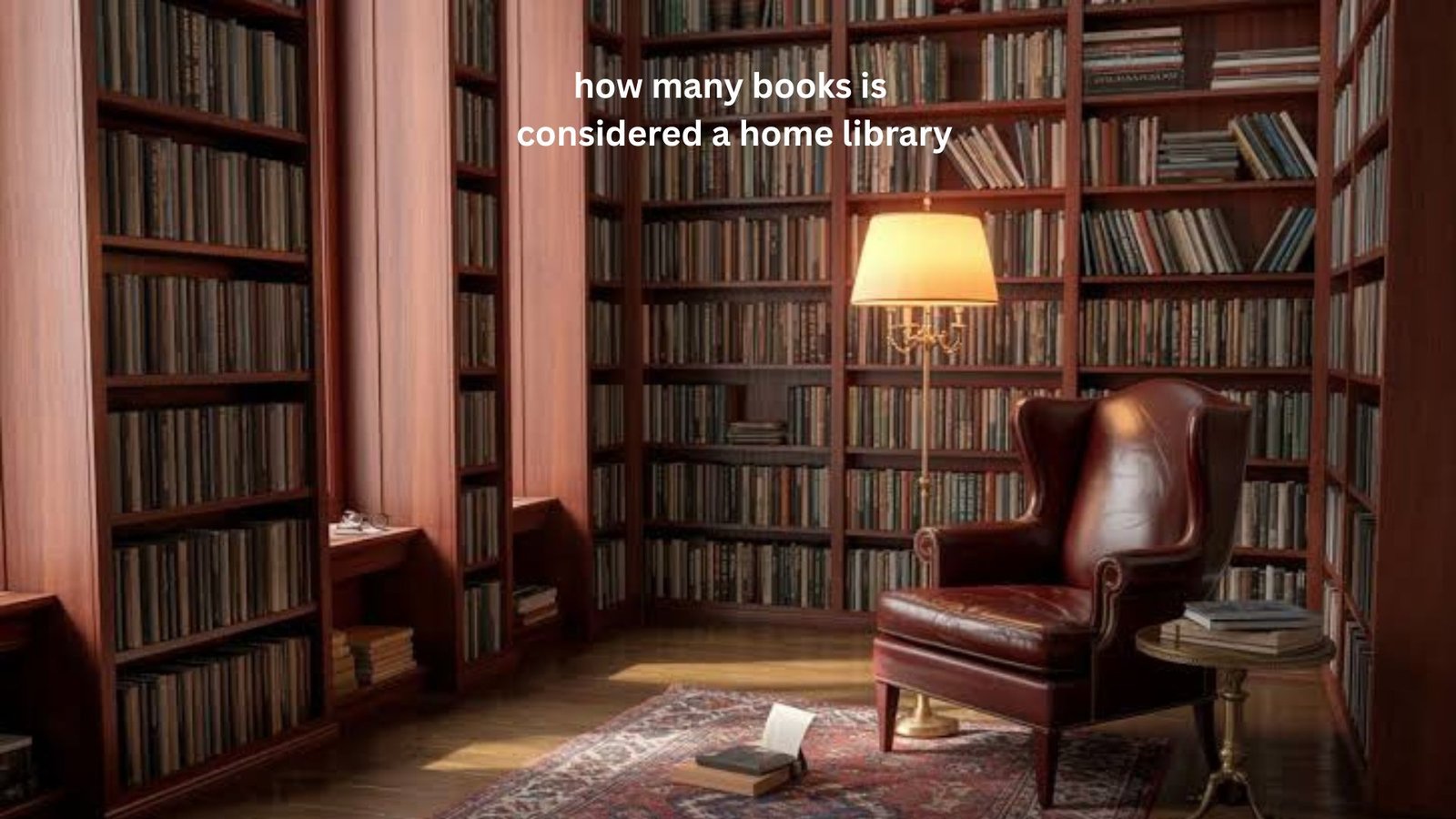
Walking into a room filled with books can feel impressive, but when does a collection actually become a home library? Is there a magic number—100 books, 500, or perhaps an entire wall of shelves? The answer is more flexible than many people expect.
There is no official minimum number of books required to call a collection a home library. In practical terms, around 100 or more thoughtfully collected books can reasonably be considered a small home library, while collections of 500, 1,000, or more books create the feeling of a substantial personal library.
What matters, however, is not simply the number of books. A home library is also defined by how the books are organized, used, displayed, and connected to the interests of the people living there. Someone with 150 carefully chosen books may have a more functional library than someone with 1,000 books stacked randomly around the house.
This guide explains what different collection sizes look like, how to decide whether your collection qualifies as a home library, how much shelf space you need, and how to build a useful library without buying books simply to reach an impressive number.
What Number of Books Is Considered a Home Library?
There is no universally accepted number, but a useful practical guide is:
- Under 50 books: Personal book collection
- 50–100 books: Growing collection
- 100–300 books: Small home library
- 300–1,000 books: Established home library
- 1,000–3,000 books: Large private library
- 3,000+ books: Extensive personal library
These categories are not formal rules. They simply provide a realistic way to understand the scale of a collection.
For most households, 100 to 300 books is enough to create a recognizable home library. At this point, you usually have enough material to dedicate shelves or a specific room area to books rather than treating them as occasional decorative objects.
The quality and purpose of the collection matter just as much as quantity.
A person who owns 120 novels, reference books, biographies, cookbooks, history books, and favorite works may have a clear personal library. Another person might own 400 books but still have little idea what is actually in the collection.
What Actually Makes a Home Library?
A home library is more than a large number of books.
Three characteristics usually make the biggest difference: intentional selection, accessible storage, and regular use.
1. The Books Have a Purpose
A home library normally reflects someone’s interests, education, profession, hobbies, or family life.
For example, a collection might include:
- 80 novels
- 30 history books
- 20 biographies
- 15 philosophy books
- 10 travel books
- 10 reference books
That is much more meaningful than simply accumulating books because they were inexpensive.
2. The Collection Is Accessible
Books piled in boxes in a garage technically belong to you, but they do not function particularly well as a library.
A home library becomes more useful when books are stored somewhere you can easily browse, remove, read, and return.
Shelving also makes it easier to understand the collection you already have.
3. You Actually Use It
This is an overlooked point.
A home library does not need to look like a traditional library. If you regularly read, research, revisit old books, recommend them to family members, or use them as references, your collection has genuine library value.
In other words, a useful 150-book library can be more valuable than an unused 1,500-book collection.
How Many Books Do You Need for a Small Home Library?
For most people, 100 to 300 books is a practical range for a small home library.
Around 100 books can fit comfortably into several bookcases, depending on book size and shelf dimensions. A collection of 200 to 300 books begins to feel much more substantial and may justify dedicating an entire wall to shelving.
A small library is especially practical for:
- Apartments
- Small houses
- Home offices
- Bedrooms
- Reading corners
- Children’s rooms
- Study spaces
You do not need a separate room.
A carefully arranged wall of books in a home office can function perfectly well as a home library.
How Many Books Make a Large Home Library?
A collection of 500 to 1,000 books is generally large enough to create a significant home library.
At this level, organization becomes much more important.
With 600 books, for example, you may no longer remember exactly where every title is. Searching through shelves becomes frustrating if books are placed randomly.
This is where simple systems become valuable.
You might organize books by:
- Subject
- Author
- Genre
- Language
- Reading status
- Family member
- Reference versus recreational reading
For a serious collection, subject-based organization is often more useful than arranging books by color or height.
How Many Books Does It Take to Fill a Room?
The answer depends heavily on shelf dimensions and book sizes.
A typical bookshelf can hold dozens of average-sized books on each shelf, but large art books, academic texts, hardcover editions, and oversized reference books take considerably more space.
A useful way to think about it is linear shelf space rather than book count.
For example, 500 slim paperbacks may require significantly less shelving than 500 large hardcover books.
This means someone planning a home library should measure available wall space before buying hundreds of books.
A common mistake is purchasing books first and discovering later that the shelving is inadequate.
A Better Planning Method
Before expanding your collection:
- Measure the wall or room available for shelving.
- Decide how much space should remain accessible.
- Estimate the number of books your shelves can hold.
- Leave some empty shelf space for future additions.
- Group books according to how you expect to use them.
Leaving approximately 10–20% of shelf capacity open can make a collection much easier to manage as it grows.
Is 100 Books a Lot?
For an individual reader, 100 books is a substantial collection.
It is enough to represent different interests and can easily create the appearance and function of a small personal library.
However, whether 100 books feels like “a lot” depends on the person.
A casual reader may consider 50 books a major collection. An academic, lifelong reader, collector, or literature enthusiast may consider 100 books relatively modest.
This is why comparing your collection with someone else’s can be misleading.
The more useful question is:
Do these books serve a purpose in your home?
If the answer is yes, the collection is already functioning as a library.
Is 500 Books a Home Library?
Yes. 500 books would comfortably qualify as a home library in most practical situations.
At 500 books, the collection is large enough that dedicated shelving is usually worthwhile. You may also benefit from keeping a simple catalog, particularly if your books cover many different subjects.
A spreadsheet, notes app, or library-management system can help you record:
- Title
- Author
- Genre
- Publication year
- Edition
- Location
- Reading status
- Whether you own multiple copies
This becomes surprisingly useful when your collection grows beyond several hundred books.
Does a Home Library Have to Be a Separate Room?
No.
This is one of the most common misconceptions about home libraries.
A home library can occupy:
- One wall in a living room
- A home office
- A hallway
- A bedroom
- A landing
- A dedicated reading corner
- An entire room
The defining feature is not the architecture. It is the intentional collection and arrangement of books.
A separate library room is wonderful if you have the space, but it is not necessary.
A 150-book collection arranged thoughtfully in a home office can absolutely be called a home library.
The Difference Between a Book Collection and a Home Library
The distinction is subtle but useful.
A book collection is primarily about ownership.
A home library is about access and use.
Imagine two households.
The first owns 700 books but keeps most of them in unopened boxes. The books were accumulated over many years but rarely accessed.
The second owns 200 books arranged by subject, with comfortable seating nearby. Family members regularly read them, use them for research, and exchange recommendations.
The second household arguably has the more functional home library.
This leads to an important insight: library quality is not directly proportional to book count.
How to Build a Home Library Without Overspending
You do not need to purchase hundreds of new books at full retail prices.
A practical home library can be built gradually.
Buy Books You Expect to Revisit
Prioritize books that you genuinely expect to read again or use for reference.
These might include:
- Favorite novels
- Professional reference books
- Cookbooks you actually use
- Histories related to your interests
- Biographies
- Classic literature
- Art and design books
- Educational books
Use Secondhand Books Strategically
Secondhand bookstores, charity shops, used-book markets, and library sales can be excellent sources for building a collection economically.
The goal should not be to buy the largest possible number of books for the lowest price.
Instead, look for books that genuinely improve your collection.
Keep a Wishlist
A wishlist prevents impulse purchases.
When you encounter an interesting title, record it rather than immediately buying it. After a few weeks, you may discover that only some of those books still interest you.
This simple habit can dramatically reduce unnecessary accumulation.
Common Mistakes When Building a Home Library
Buying Books Just to Reach a Number
Trying to reach 500 or 1,000 books can encourage unnecessary purchases.
A library should serve you rather than become a storage competition.
Ignoring Shelf Capacity
Books are heavy. Overloaded or poorly supported shelves can become a practical problem.
Choose shelving designed to carry substantial weight and pay attention to how much each shelf can safely support.
Organizing Too Complicatedly
You do not need a professional library classification system.
For most households, broad categories are sufficient.
For example:
Fiction → History → Biography → Science → Business → Reference
Simple systems are easier to maintain.
Keeping Books You Do Not Want
Sentimental books deserve consideration, but not every unwanted book needs permanent shelf space.
Every year or two, review your collection and ask:
- Would I read this?
- Would I recommend it?
- Do I need it for reference?
- Does it have sentimental value?
- Would someone else get more value from it?
If the answer is no to all five, donating or passing it along may make sense.
A Useful Way to Think About Library Size
Instead of asking only, “How many books should I own?”, consider the purpose of your library.
For Casual Reading
Around 50–150 books may be plenty.
For an Avid Reader
Around 200–500 books can provide substantial variety.
For a Family
A collection of 300–800 books can serve several age groups and interests.
For a Professional or Academic
The number may reach 500–2,000+ books, particularly when reference material is important.
For a Serious Collector
There may be thousands of books, with the collection increasingly defined by specialization, rarity, editions, or historical importance rather than simple quantity.
These are practical ranges, not requirements.
Three Less-Obvious Insights About Home Libraries
Your Library Can Reveal What You Actually Value
A shelf is a surprisingly honest record of intellectual interests.
The books you keep for years often reveal more about your priorities than the books you say you want to read.
For this reason, reviewing your shelves can be useful. It can show whether your current collection reflects who you are today or who you were several years ago.
Empty Shelf Space Is Not Wasted Space
People sometimes feel that a home library looks unfinished if shelves are not completely full.
In reality, empty space is useful.
It gives you room to add new books, makes existing titles easier to remove, and prevents shelves from becoming visually and physically overcrowded.
A library with a little breathing room is often easier to use.
The Best Library Is Designed Around Retrieval
A beautiful wall of books can look impressive, but the real test is simple:
Can you find the book you need in less than a minute?
If you cannot, the organization may need improvement.
This is particularly important once your collection reaches several hundred books. The transition from “book display” to “working library” happens when retrieval becomes intentional.
How to Organize a Home Library
For most people, a simple organization system works best.
Start by separating books into broad categories. Then arrange each category alphabetically by author if necessary.
For example:
Fiction
- A–F
- G–L
- M–R
- S–Z
Nonfiction
- History
- Science
- Business
- Psychology
- Biography
Reference
- Dictionaries
- Encyclopedias
- Manuals
- Specialized references
If several people share the library, you could also create a children’s section and a general family section.
The most important rule is consistency. A simple system that you actually maintain is better than an elaborate system that becomes confusing.
FAQ
How many books are needed to be considered a home library?
There is no official minimum number. In practical terms, around 100 books can reasonably be considered a small home library, particularly when they are intentionally selected and organized. A collection of 300 to 500 books would generally feel like a more established home library.
Is 1,000 books a large home library?
Yes, 1,000 books represents a substantial personal collection for most households. At this size, dedicated shelving and a basic cataloging system can make the collection much easier to manage. The physical space required will vary considerably depending on the size and format of the books.
Can 50 books be called a home library?
Absolutely. If those books form a deliberate collection that you regularly read or use, calling it a home library is reasonable. The term does not have to depend on reaching an arbitrary numerical threshold.
How many books can fit in a home library?
That depends on the number and dimensions of your shelves, as well as book sizes. Paperback-heavy collections can fit considerably more books into the same space than collections dominated by large hardcovers or oversized reference books. Measuring linear shelf space is therefore more useful than estimating capacity from room size alone.
What is a good number of books for a small home library?
For many households, 100–300 books is a comfortable starting range. It is enough to create variety without requiring a large dedicated room. The ideal number depends on your available space, reading habits, and the subjects you want your library to cover.
Should I keep every book I own in my home library?
No. A useful library does not need to contain every book you have ever purchased. Keeping books you enjoy, regularly use, want to reread, or consider important is usually more practical than maintaining shelves filled with books you no longer want.
Conclusion
So, how many books is considered a home library? There is no strict answer, but around 100 books can reasonably mark the beginning of a small home library, while 300–500 books creates a more established collection and 1,000 or more becomes a substantial personal library.
The number itself, however, is not the most important measure.
A good home library should reflect your interests, fit your available space, and make books easy to find and use. Whether you have 75 carefully chosen titles or 2,000 specialized volumes, the collection becomes meaningful when it supports curiosity, learning, relaxation, and everyday life.
If you are building your own library, start with books you genuinely value rather than chasing a particular number. Over time, the shelves will grow naturally—and the result will be a collection that feels like yours rather than simply a room full of books.