
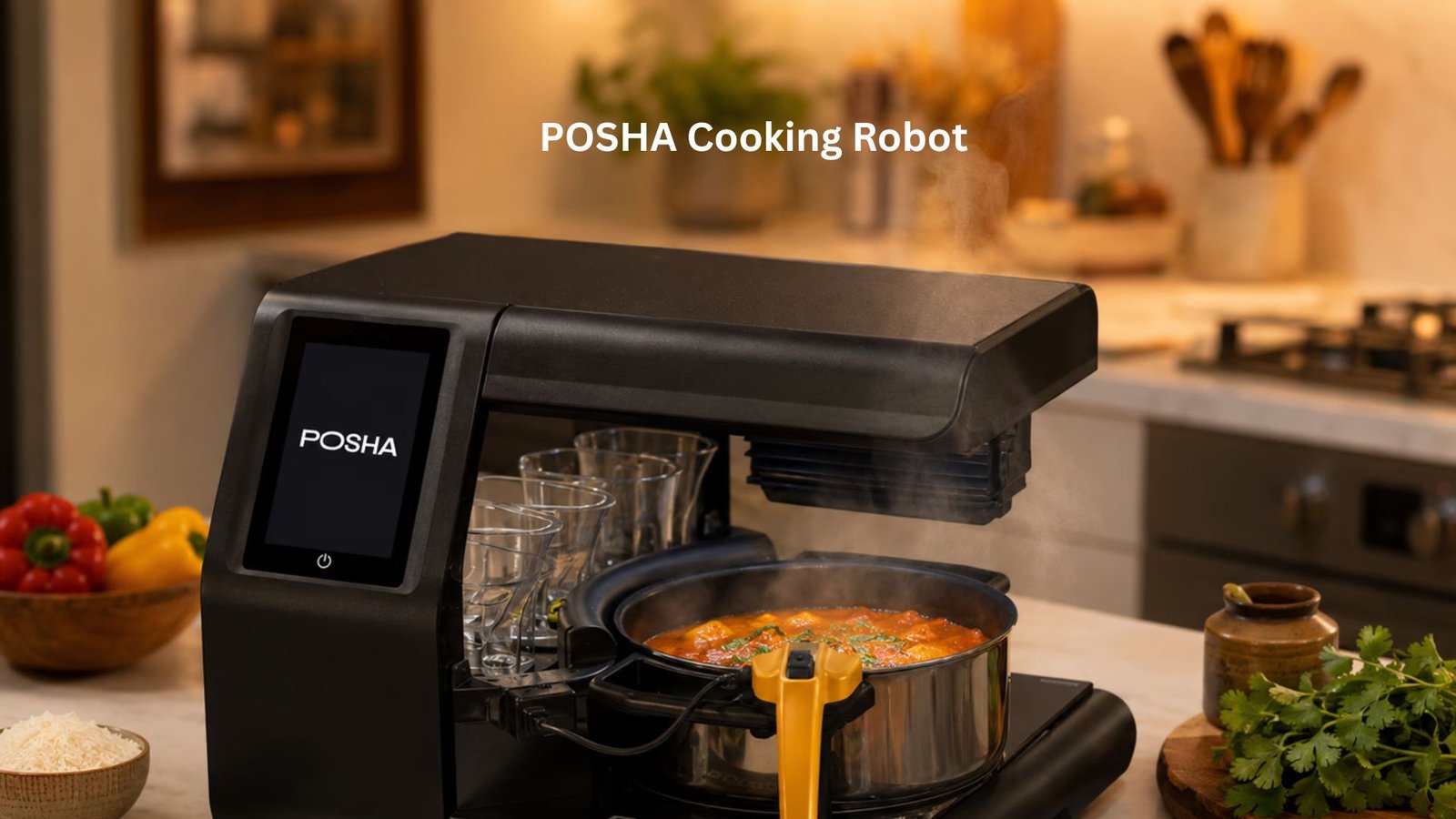
Imagine coming home after a long day and still having to chop vegetables, measure ingredients, watch a pan, and clean several utensils just to prepare one meal. This is exactly the kind of everyday problem that the POSHA cooking robot is designed to address. Rather than functioning like a simple smart appliance, POSHA is positioned around the idea of automating multiple parts of the cooking process.
But there is an important question behind the excitement: what can a cooking robot realistically do in an ordinary kitchen? Automation sounds impressive, but cooking involves timing, texture, ingredient preparation, cleaning, and personal taste. A machine that handles one recipe perfectly may not necessarily make everyday cooking easier.
This guide explains how the POSHA cooking robot works, what makes the concept different from conventional kitchen appliances, where it can genuinely save effort, and where human involvement is still important. It also looks at practical situations, common mistakes, limitations, and what you should consider before treating a robotic cooker as a replacement for traditional cooking.
What Is the POSHA Cooking Robot?
The POSHA cooking robot is a kitchen automation concept designed to reduce the amount of hands-on work required to prepare meals. Instead of simply heating food, a robotic cooking system can combine programmed cooking steps such as ingredient handling, mixing, heating, timing, and recipe execution.
The important distinction is between automated cooking and automated meal preparation.
A conventional multicooker might automatically maintain temperature or switch between cooking modes. A more advanced cooking robot attempts to coordinate several stages of a recipe so the user does not need to constantly stand beside the appliance.
In practical terms, the appeal is straightforward:
- Less time spent monitoring food
- More consistent cooking times
- Reduced need to remember individual steps
- Potentially fewer cooking utensils
- Greater convenience for repetitive meals
However, users should not assume that “robotic” means completely hands-off. Depending on the recipe and system configuration, ingredients may still need to be prepared, loaded, measured, or added at particular stages.
How Does a Cooking Robot Actually Work?
The easiest way to understand a cooking robot is to think of it as a combination of recipe software, cooking hardware, sensors, and mechanical movement.
A typical automated cooking sequence can involve several stages:
- Recipe selection – The user chooses a supported meal or cooking program.
- Ingredient preparation – Ingredients are measured, prepared, or loaded according to the recipe.
- Automated cooking – Heating and mechanical actions are controlled according to programmed instructions.
- Timing management – The system coordinates different cooking stages.
- User intervention – Some recipes may still require human input.
- Completion – The machine finishes the programmed process and indicates that the food is ready.
This approach solves one of the biggest frustrations in cooking: continuous attention.
You might not mind cooking for 30 minutes. What becomes annoying is checking the pan every few minutes, adjusting the heat, stirring at the right moment, and wondering whether the food is about to burn.
Automation can take care of some of that mental workload.
What Makes POSHA Different From a Normal Multicooker?
At first glance, a cooking robot can sound similar to a pressure cooker, air fryer, food processor, or multicooker. They overlap in some areas, but their purpose is different.
| Appliance | Main Strength | Human Involvement |
|---|---|---|
| Pressure cooker | Fast cooking | Moderate |
| Slow cooker | Long unattended cooking | Low |
| Food processor | Ingredient preparation | High |
| Multicooker | Multiple cooking methods | Moderate |
| Cooking robot | Coordinated recipe automation | Potentially lower |
The difference is coordination.
A multicooker can follow a cooking program, but it generally does not behave like a complete robotic kitchen assistant. A cooking robot aims to combine multiple actions into one coordinated workflow.
That distinction becomes especially useful when preparing meals with several sequential steps.
Where POSHA Could Be Most Useful
The biggest benefit of a cooking robot is not necessarily making gourmet food. Its strongest use case may actually be reducing repetitive daily work.
Busy Families
Families often face the same problem every evening: someone has to decide what to cook, prepare the ingredients, start cooking, monitor the food, and clean afterward.
Automation can reduce the amount of active attention required.
The time savings may be more valuable than the cooking speed itself.
People Cooking for One or Two
Cooking small portions can feel inefficient.
You may spend 20 minutes preparing ingredients for a meal that takes only 10 minutes to eat. A robotic system can make routine meals more convenient because much of the process can be standardized.
Meal Preparation
If you regularly eat similar meals, automation becomes particularly interesting.
For example, someone who prepares a simple dinner several times a week may benefit more from consistent automated cooking than someone who enjoys experimenting with a different recipe every night.
Older Adults
A simplified cooking workflow could also be useful for people who find traditional cooking physically demanding.
Reducing repetitive stirring, monitoring, and standing time may make meal preparation more manageable, although users should still consider accessibility, cleaning requirements, and how easy the controls are to operate.
The Hidden Benefit: Reducing Decision Fatigue
One of the less obvious advantages of cooking automation is psychological rather than mechanical.
People often think cooking takes time because of chopping and heating. In reality, a significant part of the burden comes from decision-making.
What should I cook?
How much should I make?
When should I add the next ingredient?
Is the heat too high?
Does it need another five minutes?
A cooking robot can turn some of these decisions into a repeatable process.
This is an important perspective because the value of automation should not be measured only by minutes saved. Reducing the number of small decisions required every evening can make cooking feel considerably easier.
What a POSHA Cooking Robot Cannot Solve
Robotic cooking still has boundaries.
A machine can follow programmed instructions, but food is not always perfectly predictable. Ingredients vary in size, moisture, ripeness, temperature, and quality.
Consider two tomatoes.
One may be large and watery while another is small and firm. Following exactly the same recipe does not guarantee identical results.
This is why human judgment remains valuable.
A skilled cook can look at a sauce and immediately recognize that it needs more reduction. A robot generally depends on the information available through its programming and sensors.
The same applies to:
- Personal taste
- Unusual ingredients
- Improvised recipes
- Texture preferences
- Last-minute substitutions
- Family-specific cooking traditions
Automation works best when expectations are realistic.
A Real-World Example: Weeknight Dinner
Imagine a person arriving home at 7:00 p.m.
With traditional cooking, the process might look like this:
- Wash and cut vegetables
- Measure ingredients
- Heat the cooking vessel
- Add ingredients in sequence
- Monitor temperature
- Stir periodically
- Adjust seasoning
- Check whether the food is finished
- Wash multiple utensils
With an automated cooking system, some of those steps can potentially be consolidated.
The biggest improvement isn’t necessarily that dinner becomes dramatically faster. Instead, the person can spend more of the cooking period doing something else.
That is the real promise of kitchen robotics: turning active cooking time into partially unattended time.
Three Practical Insights People Often Miss
1. Preparation Can Still Be the Bottleneck
Automation does not automatically eliminate all kitchen work.
If you spend 15 minutes washing, peeling, cutting, and measuring ingredients before the robot begins cooking, your total preparation time may not change dramatically.
This is why you should evaluate a cooking robot based on total meal workflow, not just the advertised cooking cycle.
2. Consistency May Matter More Than Speed
People naturally ask, “How quickly can it cook?”
A better question is:
How consistently can it produce the meals I actually eat?
If a machine takes 40 minutes but produces reliable results with little supervision, it could be more useful than an appliance that cooks in 20 minutes but requires constant attention.
3. Cleaning Determines Whether You Will Actually Use It
This is one of the most overlooked aspects of kitchen automation.
A machine can save 15 minutes of cooking effort and still become frustrating if cleaning it takes another 20 minutes.
Before buying any robotic cooking appliance, consider:
- Which parts contact food?
- Are they removable?
- How easy are they to wash?
- Can components go into a dishwasher?
- Are there narrow areas where food can accumulate?
- How difficult is maintenance?
The best kitchen appliance is usually the one you continue using six months after buying it.
Common Mistakes When Using Automated Cooking Systems
Overloading the Cooking Chamber
More ingredients do not always mean more food successfully cooked.
Overloading can interfere with mixing, heating, or even cooking consistency. Follow the manufacturer’s capacity recommendations rather than treating the machine like a larger traditional pot.
Ignoring Ingredient Size
Cutting ingredients into dramatically different sizes can create uneven results.
If one piece of vegetable is twice the size of another, they may not soften at the same rate.
Expecting Restaurant-Level Customization
Automation is strongest with repeatable recipes.
If you frequently change ingredients, cooking times, spices, and textures, you may need more manual intervention.
Assuming “Automatic” Means “No Supervision”
This is perhaps the biggest mistake.
Even highly automated kitchen equipment should be used according to its operating instructions. Hot food, steam, sharp components, and moving mechanisms still require sensible precautions.
POSHA Cooking Robot vs Traditional Cooking
The choice isn’t necessarily about replacing one with the other.
A better approach is to divide your kitchen tasks into two categories.
Good candidates for automation:
- Repetitive recipes
- Everyday meals
- Long cooking processes
- Meals requiring frequent stirring
- Standardized meal preparation
Better suited to traditional cooking:
- Experimental recipes
- Delicate finishing
- Recipes requiring constant sensory judgment
- Cooking where texture changes rapidly
- Meals where you enjoy the cooking process itself
This hybrid approach is often more practical than expecting one machine to handle everything.
Is a POSHA Cooking Robot Worth It?
Whether it is worth buying depends on what you want from it.
It may make sense if you:
- Cook frequently
- Have a busy schedule
- Prefer repeatable recipes
- Want less active supervision
- Value convenience over traditional cooking methods
It may be less attractive if you:
- Rarely cook
- Enjoy cooking manually
- Frequently improvise recipes
- Have limited counter space
- Dislike cleaning specialized appliances
Price should also be considered alongside usage frequency.
A relatively expensive appliance that is used five times a week may provide more practical value than a cheaper appliance that sits unused in a cabinet.
What Should You Check Before Buying?
Don’t buy based solely on the word “robot.”
Instead, examine the complete cooking ecosystem.
Check Recipe Compatibility
A sophisticated machine is only useful if it supports meals you actually want to eat.
Check Capacity
A machine suitable for one or two people may not be appropriate for a large family.
Check Your Kitchen Space
Robotic appliances can be larger than ordinary cooking equipment. Measure your counter and storage space before purchasing.
Understand Maintenance
Find out how frequently components need cleaning and whether parts require special care.
Consider Your Cooking Style
If you enjoy experimenting, make sure the machine provides enough flexibility rather than locking you into rigid programs.
Look at the Learning Curve
An appliance that takes weeks to understand may not feel convenient for someone looking for simple everyday cooking.
FAQ
What is a POSHA cooking robot?
A POSHA cooking robot is designed to automate parts of the meal-preparation and cooking process. Its purpose is to reduce manual supervision by coordinating cooking steps through programmed automation. The exact level of automation depends on the system, recipe, and ingredients being used.
Can a POSHA cooking robot replace a normal kitchen?
Not completely. Traditional kitchen equipment remains useful for tasks and recipes outside the robot’s capabilities. A cooking robot is better viewed as an additional cooking system that can automate suitable meals rather than a complete replacement for every kitchen appliance.
Is a cooking robot completely hands-free?
Not necessarily. Some recipes may still require ingredient preparation, loading, seasoning, or other user intervention. The amount of hands-on work depends heavily on the particular recipe and how much automation the system provides.
Are cooking robots useful for everyday meals?
They can be particularly useful for repeatable everyday meals because automation works best when recipes follow predictable processes. The greatest benefit may be reducing supervision and decision-making rather than dramatically reducing the total cooking time.
What is the biggest disadvantage of a cooking robot?
Cleaning and preparation can remain significant parts of the workflow. If ingredients still require substantial manual preparation or the cooking components are difficult to clean, the convenience advantage may be smaller than expected.
Should beginners use a cooking robot?
Yes, provided they understand its operating instructions and limitations. Beginners may appreciate automated timing and structured recipes, but they should still learn basic kitchen safety and understand what the machine is doing rather than assuming automation removes all responsibility.
Final Verdict
The POSHA cooking robot represents an interesting shift in how we think about kitchen appliances. Its most valuable feature isn’t simply the ability to cook food automatically; it is the possibility of reducing the repeated attention, decisions, and monitoring that make everyday cooking tiring.
The smartest way to evaluate it is to focus on your actual routine. If you regularly prepare the same types of meals and want to spend less time actively supervising them, automation could provide meaningful convenience. If you love improvising, tasting, adjusting, and experimenting throughout the cooking process, traditional methods may remain more satisfying.
Ultimately, the best cooking technology is not the one with the most impressive specifications. It is the one that genuinely removes friction from the meals you cook every week.