
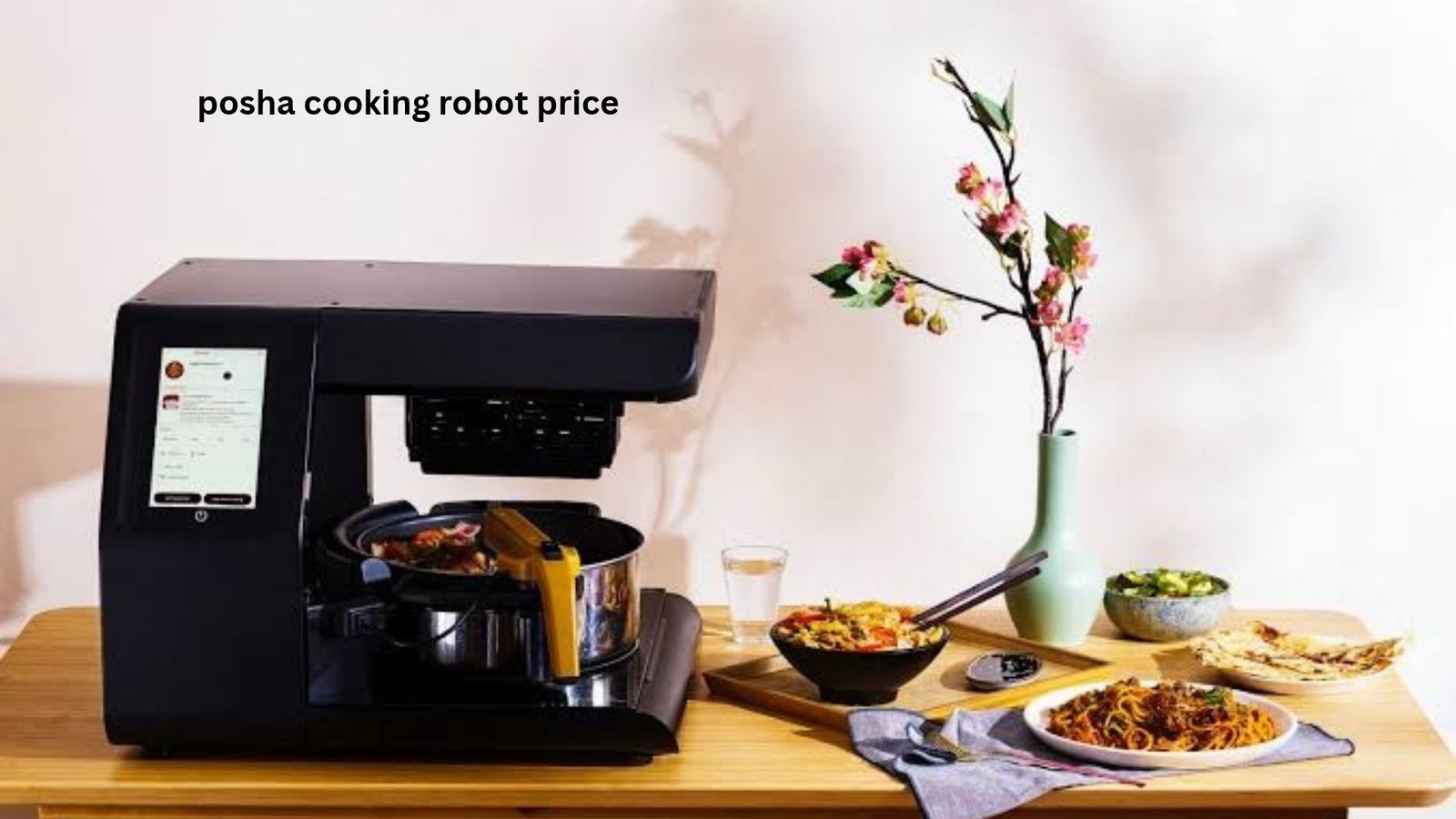
If you have ever searched for the Posha cooking robot price, you have probably noticed that it is not a typical kitchen appliance purchase. You are not simply deciding whether to spend a few hundred dollars on a multicooker. Posha is positioned as a premium robotic cooking system designed to handle much of the active cooking process while you spend your time elsewhere.
As of September 2026, Posha lists its Robot Chef at $1,750, with a limited-time price of $1,500. The company currently says the robot is available for reservation with a $25 refundable deposit, while the remaining balance is due when it ships. Posha also says that its current service is limited to the United States, so availability is an important consideration for international buyers.
But is $1,500 actually a reasonable price? That depends on what you expect the machine to replace. If you only need something to cook rice, pressure-cook beans, or stir a basic sauce, there are much cheaper options. If your real problem is finding time to prepare fresh, multi-step meals after work, Posha becomes a much more interesting proposition.
This guide breaks down the Posha cooking robot price, what you actually receive, ongoing costs, how it compares with conventional kitchen appliances, and the situations where buying one makes—or does not make—financial sense.
What Is the Posha Cooking Robot Price?
The current listed price for the Posha Robot Chef is:
- Regular price: $1,750
- Current limited-time price: $1,500
- Reservation deposit: $25
- Membership: Optional
- Shipping: Currently focused on supported U.S. locations
- Return period: Posha advertises a 30-day return policy
The $1,500 promotional figure is therefore the number most shoppers will want to use when calculating the purchase cost, while $1,750 is the listed regular price. Prices and availability can change, so the live price should always be checked before placing an order.
One useful distinction is that Posha is not simply selling a heated cooking pot. Its system combines cooking hardware, automated stirring and ingredient handling, temperature management, sensors/camera-based monitoring, and recipe software.
That explains why comparing it directly with a $100 multicooker can be misleading.
What Do You Get for $1,500?
The purchase includes considerably more than the main cooking unit.
According to Posha’s current product information, the package includes:
- Posha Robot Chef
- One Posha cooking pan
- Two spatulas
- One extended arm
- Four containers
- Twenty refillable spice pods
- One oil-and-water container
- A device preloaded with 50 recipes
The cooking pan is described as dishwasher-safe, PFOA-free, non-toxic and made from three-ply stainless steel.
There are also optional accessories, including a weighing scale and spice rack.
This matters when calculating the real purchase cost. A machine advertised at $1,500 can become considerably more expensive if essential accessories are actually required for your preferred cooking style. With Posha, however, the basic machine is designed to function without purchasing every available add-on.
Does Posha Require a Monthly Subscription?
This is one of the most important questions to ask before buying.
No, a Posha robot does not require a membership simply to operate.
Posha provides a Co-Pilot mode that allows owners to manually control the machine. Owners also receive access to a free collection of Essential recipes.
The optional Posha Circle Membership unlocks the full recipe library and additional guided-cooking functionality. Current membership pricing is:
- $14.95 per month
- $139.95 per year
- 90-day free trial for new members
The company says no payment method is required to start the free trial.
That distinction changes the ownership calculation.
If you purchase the robot for $1,500 and decide that the free recipe collection and manual Co-Pilot mode are enough, you do not necessarily have another recurring software bill.
If you want the full recipe ecosystem and guided experience, budgeting roughly $140 per year for an annual membership is more realistic.
Why Does a Cooking Robot Cost $1,500?
The easiest mistake is to compare Posha with an ordinary programmable cooker.
A conventional appliance might heat food according to a timer. A more advanced appliance may have multiple cooking modes. Posha attempts to automate several individual cooking decisions.
For supported recipes, Posha is designed to:
- Monitor cooking stages.
- Add ingredients at appropriate points.
- Stir food automatically.
- Adjust heat.
- Manage cooking time.
- Use computer vision and software to monitor what is happening.
- Allow the user to step away while the recipe progresses.
The company’s description emphasizes its built-in camera and culinary AI, which are intended to detect cooking stages and help control timing, heat and stirring.
This is the central reason for its premium price.
You are paying partly for the physical appliance, but also for the engineering required to coordinate software, sensors, mechanical movement and cooking.
Posha vs. a Normal Multicooker
For many shoppers, this is the comparison that matters most.
A conventional multicooker is usually better if your priority is:
- Low purchase price
- Pressure cooking
- Large batch meals
- Simple operation
- Meal preparation with minimal technology
Posha makes more sense if your priority is:
- Hands-off cooking
- Multi-step recipes
- Automatic stirring
- Automated cooking decisions
- Recipe guidance
- Fresh meals without standing beside the stove
Think about two different evenings.
Scenario 1: The batch cook
You prepare chili on Sunday, put it into containers and eat it throughout the week.
A conventional multicooker may be the smarter purchase.
You do not need a $1,500 robotic system for this type of cooking.
Scenario 2: The busy weeknight
You arrive home at 6:30 p.m., need dinner, have several ingredients available, but do not want to spend 40 minutes standing over a pan.
This is where Posha’s value proposition becomes stronger.
You still need to buy and prepare ingredients, but the machine is intended to handle much of the active cooking process.
The Hidden Cost: Your Ingredients Still Matter
One frequently overlooked point about the Posha cooking robot price is that $1,500 does not mean you have purchased dinner.
Posha does not magically create food from nothing.
You still need ingredients.
You may need to:
- Buy vegetables
- Purchase meat, tofu or other proteins
- Prepare ingredients where required
- Keep spices stocked
- Wash some ingredients
- Clean the cooking components
The robot reduces active cooking work, but it does not eliminate grocery shopping or kitchen preparation.
This is an important reality check for anyone expecting a completely autonomous kitchen.
A More Useful Way to Calculate the Cost
Instead of asking, “Is $1,500 expensive?”, ask:
How many hours of cooking-related work will I realistically save each month?
Suppose a household normally spends 30 minutes actively cooking dinner five times per week.
That is roughly:
2.5 hours per week
or approximately:
130 hours per year.
If Posha meaningfully reduces active cooking time on a large proportion of those meals, the value is not just about the price of the appliance.
It is about what those recovered hours are worth to you.
This is one of the less obvious ways to evaluate a cooking robot.
A person earning a high income, working long hours, caring for children or simply valuing free evenings may view $1,500 very differently from someone who genuinely enjoys cooking every day.
A Second-Year Cost Perspective
The first year is naturally the most expensive because you have to purchase the hardware.
At the current promotional price:
Robot: $1,500
Optional annual membership: $139.95
That makes approximately $1,639.95 before applicable taxes or other costs if you choose the annual membership.
After the first year, you are no longer buying the main hardware again.
That means the economics become more attractive if you use the robot regularly and keep it for several years.
For example, spreading a $1,500 purchase over three years gives a simple hardware-equivalent cost of approximately $500 per year, before considering membership, maintenance, electricity and food.
That does not make the robot cheap. It simply gives a more realistic picture of long-term ownership.
A Third Insight: Usage Frequency Matters More Than the Sticker Price
A $1,500 appliance used three times a week can potentially provide more value than a $500 appliance used once every two weeks.
Consider two hypothetical owners.
Owner A buys Posha because it looks futuristic but cooks only once or twice a week.
The effective cost per use could remain very high.
Owner B uses it four or five nights a week.
For this person, the same $1,500 purchase becomes part of a daily routine.
This suggests a practical buying rule:
Do not buy Posha because you like the idea of a cooking robot. Buy it if you can identify at least several meals each week that you genuinely expect it to handle.
That is a much better test than simply comparing the price with another appliance.
Who Should Consider Buying Posha?
Posha may be worth considering if you:
- Have a busy work schedule
- Want more home-cooked meals
- Like trying different cuisines
- Prefer automated cooking
- Do not enjoy standing beside the stove
- Have enough kitchen counter space
- Are comfortable spending around $1,500 on a premium appliance
- Expect to use it several times a week
It can be particularly interesting for households where cooking is not difficult because of skill, but because of time and attention.
That distinction is important.
Who Probably Should Not Buy It?
A high price does not automatically mean a product is bad. It may simply mean it is solving the wrong problem for you.
Posha may not make sense if:
- You love traditional hands-on cooking.
- You mainly cook simple meals.
- You already own several capable kitchen appliances.
- Your budget is tight.
- You mostly batch-cook.
- You expect completely autonomous meal preparation.
- You live somewhere Posha does not currently ship or provide service.
The last point is particularly important for international shoppers. Posha’s current terms specify U.S.-only sales and service zones rather than worldwide availability.
Common Mistakes Buyers Make
1. Comparing it with the cheapest multicooker
This ignores what the machine is designed to automate.
If you only want pressure cooking, buy the cheaper appliance.
2. Forgetting the subscription
Membership is optional, but shoppers who want the complete recipe library should include it in their budget.
3. Assuming “robot” means zero preparation
You still need ingredients and some level of kitchen preparation.
4. Buying it without planning your weekly meals
A premium cooking appliance becomes poor value when it sits unused.
5. Ignoring location and service availability
International buyers should be especially careful because current shipping and service coverage is limited.
How Posha Compares With a Premium Cooking System
Posha sits in a relatively unusual section of the kitchen-appliance market.
Basic multicookers can cost dramatically less. Premium guided cooking systems can reach four figures. Posha’s current $1,500 promotional price therefore places it firmly in the premium category.
The interesting difference is its emphasis on automation rather than simply providing many cooking programs.
For someone who wants guided recipes but still wants to remain involved, another premium cooking system may be more suitable.
For someone whose main goal is to reduce the amount of active attention required during cooking, Posha’s approach is more distinctive.
Is the Posha Cooking Robot Worth $1,500?
For the right household, it can be.
But the answer is not simply “yes” because the technology is impressive.
At $1,500, Posha is a luxury-level kitchen purchase. The strongest argument for buying it is not that it can perform tasks that no other appliance can perform. It is that it attempts to reduce the amount of attention required to make a proper meal.
That is a subtle but important difference.
If your biggest cooking problem is chopping vegetables, a food processor may be better.
If your problem is pressure cooking, buy a multicooker.
If your problem is baking, buy a suitable oven.
But if your recurring problem is “I want a fresh dinner, but I don’t want to spend my evening actively cooking it,” Posha is much closer to the problem you are actually trying to solve.
FAQ
How much does the Posha cooking robot cost?
The Posha Robot Chef is currently listed at $1,750, with a limited-time price of $1,500. Posha also allows customers to reserve the machine with a $25 refundable deposit, with the remaining balance due when it ships. Taxes and other applicable charges can affect the final amount.
Does Posha require a subscription?
No. Posha can be used in Co-Pilot mode without a membership, and owners receive access to Essential recipes at no additional subscription cost. The optional Posha Circle membership provides access to the full recipe library and currently costs $14.95 monthly or $139.95 annually.
Is the Posha cooking robot worth the $1,500 price?
It depends primarily on how frequently you will use it and how much you value reduced cooking effort. Someone who cooks simple meals occasionally may get better value from a conventional appliance. A busy household using Posha several nights per week has a stronger case for the investment.
What comes with the Posha Robot Chef?
The current package includes the Posha device, a cooking pan, two spatulas, an extended arm, four containers, 20 refillable spice pods and an oil-and-water container. The device also comes with 50 recipes, while additional accessories such as a weighing scale and spice rack are available separately.
Can you use Posha without the membership?
Yes. Posha states that owners can continue using the robot in Co-Pilot mode without a subscription and can access its free Essential recipe collection. The membership is mainly for customers who want the broader recipe library and its associated guided cooking experience.
Does Posha ship internationally?
At present, Posha’s official information indicates that it ships and provides in-warranty service only within specified U.S. service areas. International buyers should therefore not assume that the $1,500 price includes availability or support in their country.
Final Verdict
The Posha cooking robot price puts it firmly into premium kitchen-appliance territory. At the current $1,500 promotional price—or $1,750 listed price—it is substantially more expensive than an ordinary multicooker, food processor or smart cooking appliance.
The reason to consider it is not simply the number of cooking functions. Posha is designed around a different idea: reducing the amount of attention you have to give the cooking process itself.
That makes the best buying question surprisingly simple: Will you use it several times a week to solve a real time problem?
If the answer is yes, the price becomes easier to justify over several years of use. If the answer is no, spending $1,500 on a machine that spends most of its time on the counter is difficult to defend.
The smartest approach is therefore to evaluate Posha against your actual weekly routine rather than against its futuristic appearance. A cooking robot only becomes valuable when it consistently gives you something more useful than another kitchen appliance: time back.