Finding an old ring in a jewelry box, buying a second-hand stone, or receiving a diamond as a gift can leave you wondering: Is this actually a real diamond? The good news is that you can perform several simple checks at home before paying for a professional evaluation.
Learning how to tell if a diamond is real at home starts with understanding what these tests can—and cannot—prove. A real diamond has distinctive physical properties, including high thermal conductivity, exceptional hardness, and characteristic optical behavior. However, no simple household test can reliably establish that a stone is a natural diamond rather than a laboratory-grown diamond, and some diamond simulants can fool basic tests.
This guide walks you through the safest practical checks, explains why they work, identifies misleading tests, and shows you when it is time to stop testing and have the stone professionally examined.
What Does “Real Diamond” Actually Mean?
Before testing a stone, clarify what you are trying to determine.
A natural diamond formed underground over geological timescales. A laboratory-grown diamond has essentially the same chemical composition and crystal structure as a natural diamond but is produced under controlled conditions.
Both are diamonds.
Then there are diamond simulants, such as cubic zirconia and moissanite. They may look similar to diamond but are different materials.
So, if you are testing a loose stone at home, there are really three questions:
- Is the stone a diamond?
- If it is a diamond, is it natural or laboratory-grown?
- Is the stone being represented accurately in terms of quality and value?
Home tests are most useful for the first question. They generally cannot reliably answer the second or third.
The Best Ways to Test a Diamond at Home
Some home tests are more useful than others. If you are checking a valuable stone, start with methods that do not risk scratching, chipping, or damaging it.
1. Try the Fog Test
The fog test is one of the easiest checks.
Hold the diamond between two fingers, or hold the setting carefully, and breathe onto the stone as you would fog a window.
Watch how quickly the condensation disappears.
Because diamond conducts heat extremely well, moisture generally disperses quickly from its surface. If the fog remains visible for several seconds, that can be a reason to question the stone.
However, do not treat this as proof.
Room temperature, humidity, cleanliness, and the condition of the stone all affect the result. Moissanite, for example, can behave similarly enough that a fog test cannot reliably distinguish it from diamond.
Practical takeaway: A quick-clearing fog is encouraging, but a fog test alone cannot authenticate a diamond.
2. Examine the Stone Under Good Lighting
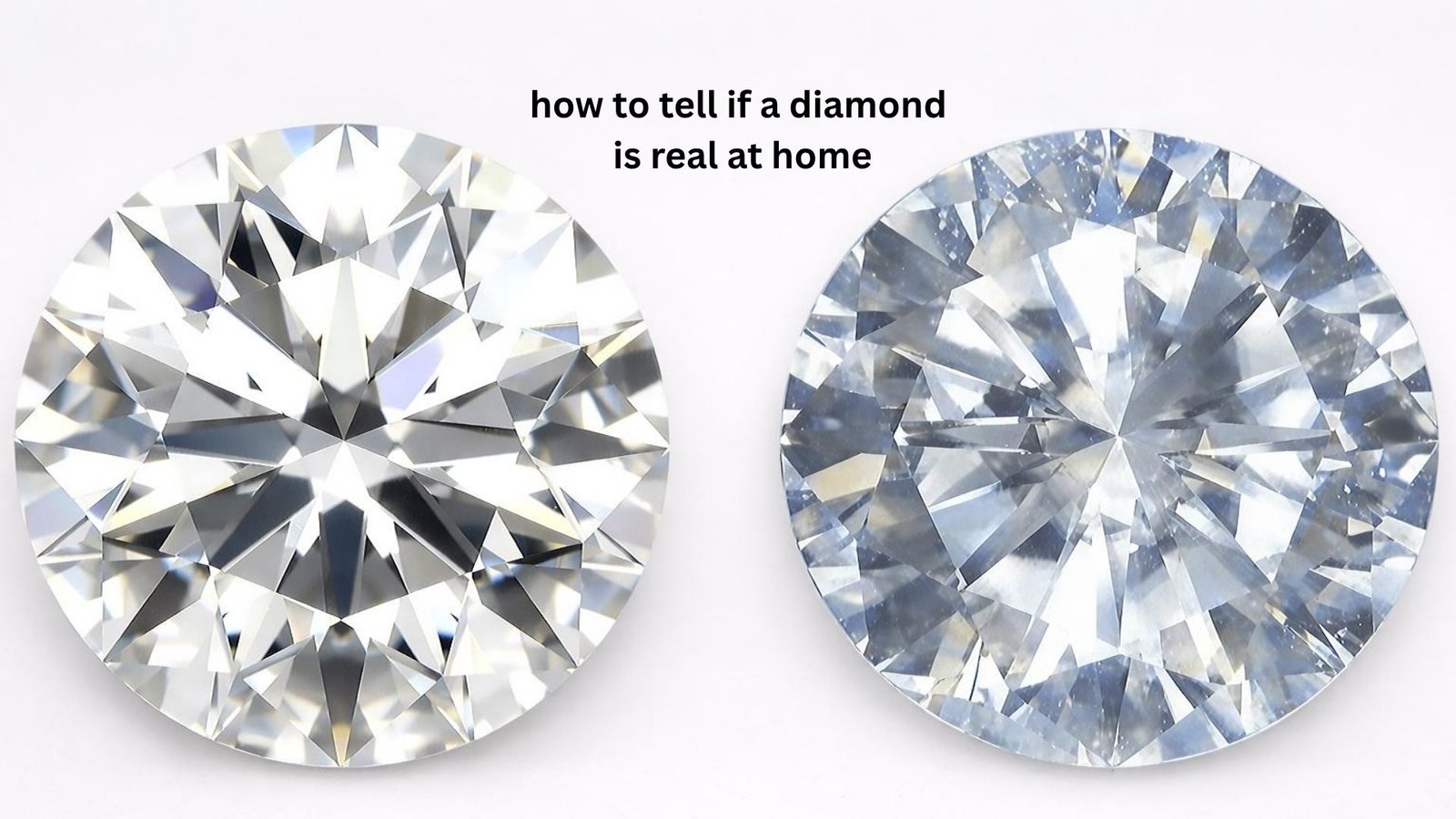
Look closely at the stone rather than simply judging whether it “sparkles.”
A diamond’s brilliance comes from the way it reflects and refracts light through its facets. Cut quality has a huge effect on appearance, so even a genuine diamond can look dull if it is poorly cut, dirty, or damaged.
Look for:
- Sharp, well-defined facet edges
- Strong flashes of white light
- Controlled flashes of spectral color
- A balanced pattern of reflections
- No obvious bubbles inside the stone
Be careful with one popular misconception: more rainbow color does not automatically mean a better diamond. Excessive colored flashes can occur in some simulants, but diamonds also produce fire.
The overall optical pattern matters more than one visual characteristic.
3. Check Whether It Is Mounted or Loose
This is an underrated part of home testing.
A loose stone gives you considerably more information than a diamond mounted in a ring. You can examine its edges, pavilion, transparency, and behavior from different angles.
A mounted stone can hide important details.
For example, if a stone is set in a ring, avoid attempting risky tests simply because you cannot inspect the underside. You can still examine the stone with a loupe, check its setting, and use a suitable diamond tester, but professional testing becomes more valuable.
Unique practical insight: The setting itself can provide clues about the purchase, but it does not prove the stone is genuine. A high-quality gold or platinum setting can contain a fake stone, while an inexpensive setting can contain a genuine diamond.
Can You Use the Newspaper Test?
You may have heard that you can place a diamond over printed words and see whether you can read the letters through it.
The theory is that diamond’s strong refractive properties should prevent you from seeing text clearly through a properly cut stone.
There is some useful optical reasoning behind the test, but it has major limitations.
It works best, if at all, with a loose, transparent, round brilliant-style stone. A mounted stone, unusual cut, poor cut, or certain simulants can produce confusing results.
If you can clearly see individual letters through a loose stone, that may raise suspicion. But the result is not a reliable authentication method.
Never reject a diamond solely because this test produces an unexpected result.
What About the Water Test?
The water test is often presented as a simple way to identify a real diamond.
The basic idea is to drop a loose stone carefully into a glass of water. Because diamond is relatively dense, it should sink.
The problem is that many other gemstones and synthetic materials also sink.
Cubic zirconia, for example, is also dense enough to sink. Therefore, sinking does not prove that a stone is diamond.
Likewise, a floating stone should not automatically be classified as fake without considering what material it is and how the test was performed.
Verdict: The water test is a poor authentication test and should be treated only as a very rough observation.
Does a Diamond Scratch Glass?
This is one of the most common tests—and one of the worst recommendations for valuable jewelry.
Diamond ranks at the top of the Mohs hardness scale, so it can scratch glass. But that does not mean you should deliberately drag your diamond across a glass surface.
Why?
Because the test can:
- Scratch or damage the glass
- Damage a gemstone setting
- Chip a diamond at a vulnerable edge or point
- Produce misleading results
- Damage another stone if you mistake the material
Hardness also does not equal toughness. A diamond is extremely hard, but it can still chip under a sufficiently strong impact.
Skip the scratch test. There is little reason to risk a valuable stone when safer testing options exist.
Can a Diamond Tester Tell If a Diamond Is Real?
A diamond tester can be much more useful than household tricks because it measures a physical property rather than relying on appearance.
Many handheld testers measure thermal conductivity. Diamond conducts heat exceptionally well, allowing suitable instruments to distinguish it from many common simulants.
However, there is an important catch.
Some testers can be fooled by moissanite
Moissanite has thermal properties that can cause problems for basic thermal diamond testers.
Some modern instruments therefore test additional properties, such as electrical conductivity or use combined testing methods.
If you are considering buying or borrowing a tester, understand what it actually measures. A cheap device marketed simply as a “diamond tester” is not necessarily capable of identifying every diamond simulant.
Clean the stone first
This is another practical detail people often overlook.
Oil, lotion, dirt, and residue can interfere with testing. Clean and dry the stone according to the tester manufacturer’s instructions before taking a reading.
Then follow the device’s calibration and probe-placement instructions carefully.
One isolated reading should not automatically determine whether the stone is genuine.
How to Tell Diamond From Moissanite at Home
Moissanite deserves special attention because it is one of the most convincing diamond alternatives.
Under close observation, you may notice that moissanite produces strong, sometimes unusually prominent rainbow flashes. Its optical behavior is also different because moissanite is birefringent, meaning light can split as it passes through the material.
In some cuts and viewing angles, this can create a doubled appearance of facet edges when viewed through the stone.
But this is not something everyone can identify confidently with the naked eye.
If a stone looks unusually fiery, do not conclude immediately that it is fake. Instead, consider it a reason to use a proper testing instrument or seek professional identification.
How to Use a Jeweler’s Loupe
A 10× loupe can help you inspect a stone more carefully.
Hold the loupe close to your eye, then bring the stone toward it rather than constantly moving the loupe back and forth.
Look for:
- Facet junctions
- Chips or abrasions
- Internal inclusions
- Surface-reaching fractures
- The symmetry of the cut
- Abrupt facet edges
- Signs of wear
Natural diamonds commonly contain inclusions, but a perfectly clean stone is not automatically fake. Laboratory-grown diamonds can also be very clean, and some natural diamonds have extremely high clarity.
Likewise, inclusions alone do not prove natural origin.
A loupe is an inspection tool, not a certification instrument.
A Better Home-Testing Process
Instead of relying on one viral trick, use a sequence of low-risk checks.
Step 1: Identify the situation
Ask yourself whether the stone is:
- Loose or mounted
- Newly purchased or inherited
- Accompanied by paperwork
- Being sold as natural or laboratory-grown
- Valuable enough to justify professional testing
Step 2: Clean it carefully
A dirty diamond can appear dull and can interfere with some testing methods.
Step 3: Examine it under strong, neutral lighting
Look at the stone from several angles and assess its cut and optical behavior.
Step 4: Use a loupe if available
Inspect the facets, inclusions, edges, and overall construction.
Step 5: Use a reputable multi-function tester
If you need stronger evidence, use an instrument designed to distinguish diamond from common simulants.
Step 6: Stop before doing anything destructive
Do not scratch glass, hit the stone, heat it, or use chemicals.
Step 7: Get professional verification for valuable stones
If the stone may be worth significant money, professional identification is the sensible final step.
Tests You Should Not Trust on Their Own
The internet is full of diamond tests that sound scientific but provide weak evidence.
| Home test | Useful? | Main problem |
|---|---|---|
| Fog test | Somewhat | Not conclusive |
| Water test | Very limited | Many materials sink |
| Newspaper test | Limited | Depends heavily on cut |
| Glass scratch test | Avoid | Can cause damage |
| Looking for rainbow sparkle | Limited | Appearance varies by cut |
| Loupe inspection | Useful | Requires experience |
| Basic thermal tester | Useful | May struggle with moissanite |
| Professional testing | Best | Most reliable for valuable stones |
The important lesson is that authentication works better as a process than as a single trick.
Common Mistakes People Make
Mistake 1: Assuming an expensive ring must contain a real diamond
The price of the jewelry does not authenticate the gemstone.
Mistake 2: Assuming visible inclusions mean it is natural
Inclusions can help with identification, but they are not by themselves proof of origin.
Mistake 3: Assuming a lab-grown diamond is fake
Laboratory-grown diamonds are genuine diamonds. The distinction is primarily their origin, not whether they are “real” diamond material.
Mistake 4: Trusting one cheap tester
A tester can produce a reading without necessarily answering every question you have about the stone.
Mistake 5: Performing destructive experiments
A viral test is not worth damaging an expensive ring.
Mistake 6: Ignoring the paperwork
If the stone was sold with a grading report, examine the report details and compare them with the stone and inscription, where applicable.
Three Less-Obvious Clues Worth Knowing
The setting can hide important information
If you cannot inspect the pavilion because the stone is heavily covered by the setting, your ability to evaluate it visually is reduced. This is one reason professional testing can be especially useful for mounted jewelry.
Cut quality can make a real diamond look “fake”
People sometimes expect every genuine diamond to explode with sparkle. In reality, a poorly cut, dirty, damaged, or badly proportioned diamond can look surprisingly lifeless.
So lack of sparkle is not proof of a fake.
“Real” and “valuable” are different questions
A stone can be a genuine diamond but still have modest monetary value because of its size, color, clarity, cut, condition, treatment, or market demand.
Conversely, an attractive simulant can look impressive without being a diamond.
That distinction is particularly important when evaluating inherited jewelry or second-hand purchases.
When Should You Get a Diamond Professionally Tested?
Professional testing makes the most sense when money, insurance, inheritance, or resale value is involved.
Consider professional identification if:
- Someone is asking you to pay a significant amount for the stone.
- You inherited the jewelry and do not know its history.
- The seller claims it is a natural diamond.
- You suspect it could be moissanite or another simulant.
- The stone came without reliable documentation.
- You want to insure or sell the jewelry.
- A home tester gives an unclear or contradictory result.
A qualified gemologist or reputable gemological laboratory can use specialized equipment that goes far beyond household tests.
This is particularly important when the question is not merely “Is this a diamond?” but “Is this a natural diamond?”
Frequently Asked Questions
How can I tell if a diamond is real at home without a tester?
Start with non-destructive observations such as the fog test, careful visual inspection, and examination with a 10× loupe. These can provide clues but cannot guarantee that a stone is a diamond. For a valuable stone, professional testing is much more reliable than combining several household tricks.
What is the easiest way to test a diamond at home?
The fog test is probably the easiest because it requires no equipment. However, it should only be treated as a preliminary check because environmental conditions and some diamond alternatives can produce similar results. A proper diamond tester provides stronger evidence.
Can a real diamond fail a home diamond test?
Yes. Poor technique, contamination, an unsuitable tester, or testing the wrong part of a mounted stone can produce confusing results. Some instruments also have limitations when dealing with particular simulants or laboratory-grown stones. An unexpected reading should be investigated rather than treated as automatic proof that the diamond is fake.
How can I tell if a diamond is real without scratching it?
You can examine its optical behavior, perform a cautious fog test, inspect it under magnification, and use an appropriate electronic tester. These methods avoid the unnecessary risk of scratching the stone or damaging the jewelry. For an expensive diamond, professional testing is the safest approach.
Can you tell if a diamond is natural at home?
Usually not with confidence. Home methods may help determine whether a stone is likely to be diamond, but distinguishing a natural diamond from a laboratory-grown diamond can require specialized equipment and expertise. Documentation and professional laboratory testing are much more dependable for determining origin.
Does a real diamond sink in water?
Yes, a diamond is dense enough to sink in water, but this does not prove that it is a diamond. Several diamond simulants are also dense and will sink. Therefore, the water test has very little value as a standalone authentication method.
Conclusion
If you want to know how to tell if a diamond is real at home, resist the temptation to rely on one dramatic test. Start with safe observations: clean the stone, examine its cut and reflections, try a cautious fog test, and use magnification if you have it. A quality diamond tester can provide stronger evidence, but even electronic testers have limitations.
Most importantly, avoid destructive tricks such as scratching glass. If the stone has meaningful financial or sentimental value, professional testing is a far better investment than risking damage based on an internet hack.
And remember the most important distinction: a laboratory-grown diamond is still a real diamond. If your real question is whether a stone is natural, that requires a different level of examination than simply determining whether it is diamond material.